Why Period Pain Moves to Your Lower Back and What That Means
Quick Answer: Menstrual pain reaches the lower back because the uterus and the skin of the lower back share spinal nerve levels - the brain cannot always tell where a signal from a deep organ originated, so it maps it onto the body wall. A backward-tilted uterus, higher prostaglandin levels, and existing tension in the lower back all make that referral more likely. Pain that is purely referred moves with your cycle and responds to the same anti-inflammatory timing that helps cramps; pain that persists between periods or worsens over months is worth investigating separately.
The location changed. That usually means the referral pattern changed, not that something new is wrong.

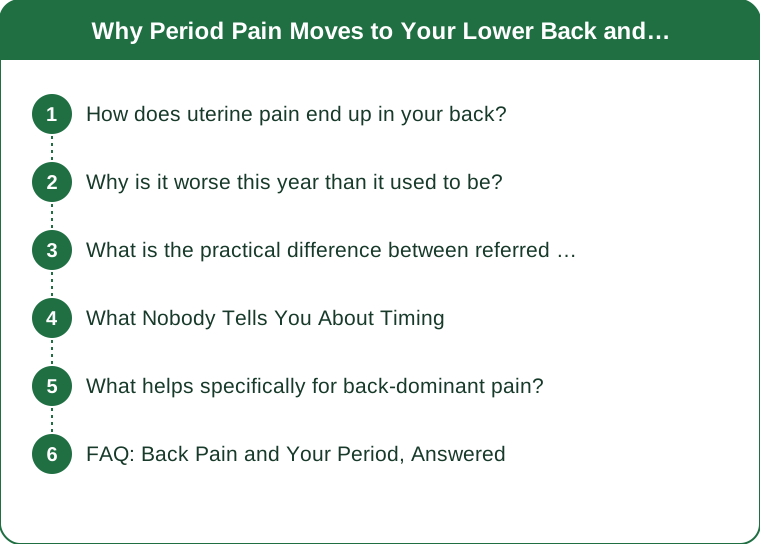
How does uterine pain end up in your back?
The uterus sends signals through the same spinal segments that serve the lower back and upper buttocks, roughly T10 through L1 and S2 through S4.
The brain has no dedicated map for internal organs, so it interprets the signal using the body-wall territory that shares those nerve roots - this is referred pain, the same mechanism that puts heart pain in the left arm.
Referral gets stronger as the signal gets stronger. A mild cramp stays local; an intense one recruits more of the shared territory, which is why bad months feel back-heavy and mild months do not.
A retroverted uterus tilts toward the spine, which shifts pressure and referral backward and is a common reason the pattern differs between two people with identical periods.
Existing tension in the lower back lowers the threshold. A back already irritated by sitting or training registers the referred signal much more readily.
And the pattern can genuinely change over a lifetime with childbirth, weight change, posture, and age all altering the mechanics.
Why is it worse this year than it used to be?
Prostaglandin levels vary between cycles, and higher levels mean stronger contractions and more referral. A heavier cycle usually means a more back-dominant one.
More sitting means a more sensitised lower back. A desk-heavy year changes baseline tissue tolerance, and the same period pain then lands on less tolerant ground.
Training load matters in both directions - a sudden increase leaves the back sore and receptive, while very low activity reduces circulation and tolerance.
Sleep position during the heaviest nights often shifts to something less supportive, adding a mechanical layer on top of the referral.
Stress raises pain sensitivity broadly, and referred pain is particularly responsive to that amplification.
And age changes the balance. Many people find pain shifts from sharp and low to dull and posterior across their thirties, which is common rather than concerning by itself.
What is the practical difference between referred and structural pain?
Referred pain tracks the cycle tightly - it arrives with the period, peaks in the first day or two, and resolves. Structural back pain does not care what day it is.
Referred pain is diffuse and hard to point at. If you can put one finger on it, that points toward a musculoskeletal source instead.
Referred pain responds to anti-inflammatory timing started before the pain peaks. Mechanical back pain responds better to movement and position change.
Heat helps both, which is why heat is not a useful diagnostic even though it is a useful treatment.
Pain that worsens progressively over several cycles, or that persists between periods, is the pattern worth taking to a clinician - endometriosis and adenomyosis both present this way and both are routinely diagnosed late.
And pain with leg numbness, weakness, or bladder changes is a different conversation entirely and warrants prompt assessment. This is general information, not medical advice.

What Nobody Tells You About Timing
Anti-inflammatories work far better before the peak than during it. Prostaglandin production is already underway once pain is severe, and blocking production is easier than reversing its effects.
Starting the day before bleeding, or at the first sign, is the standard advice for people with predictable cycles - not waiting until it hurts, which is what most people do.
Heat applied early is more effective than heat applied late, and continuous low heat outperforms intermittent high heat.
Walking beats lying down for back-dominant pain because it moves the pelvis and increases circulation, even though lying down is what the pain makes you want.
Hydration and sodium matter more than expected during heavy days, and dehydration amplifies both cramping and headache.
And tracking which cycles are back-dominant is genuinely useful - the pattern often correlates with cycle heaviness, which helps you decide when to pre-empt rather than react.
What helps specifically for back-dominant pain?
Continuous heat on the lower back, not the abdomen, when that is where the pain is. A wearable heat patch outperforms a hot water bottle for anyone who has to move around.
Gentle pelvic movement - cat-cow, supported child’s pose, slow walking - for five to ten minutes several times a day rather than one long session.
Support the lower back when seated. A rolled towel at the lumbar curve reduces the mechanical contribution meaningfully on bad days.
Side-lying with a pillow between the knees at night keeps the pelvis neutral and is the position most people find reduces morning severity.
Regular activity across the whole month raises tissue tolerance, which is why the people who move consistently report less back-dominant pain even with the same cycles.
And consider whether a TENS unit is worth trying - the evidence for menstrual pain is reasonable, and it targets exactly this kind of referred, diffuse pain. This is general information, not medical advice.
FAQ: Back Pain and Your Period, Answered
Why did my period pain move to my back?
Usually a change in cycle heaviness, uterine position, or lower back sensitivity. The referral pathway was always there; what changed is how strongly it is being recruited.
Is back-dominant period pain a sign of endometriosis?
Not by itself. The pattern that raises concern is pain that worsens over cycles, persists between periods, or is accompanied by pain with sex or bowel movements.
Should I use heat on my back or my stomach?
Wherever the pain is. Both work through the same mechanism, and there is no reason to heat the abdomen if the pain sits in the back.
Does exercise make it worse?
Usually the opposite. Gentle movement helps back-dominant pain more than rest, though intensity should follow how you feel.
When should I take painkillers?
For predictable cycles, before the pain peaks rather than after. Ask a pharmacist or doctor about what is appropriate for you.
When should I see a doctor?
If pain is disabling, worsening cycle over cycle, persisting between periods, or accompanied by leg symptoms or bladder changes. This is general information, not medical advice.
TL;DR:
- The uterus and lower back share spinal nerve levels, so strong uterine signals get mapped onto the back - this is referred pain, not a separate problem.
- Heavier cycles, a retroverted uterus, and an already-sensitised back all push pain backward.
- Referred pain tracks your cycle and is diffuse; pain you can point to with one finger, or that persists between periods, is a different question.
- Anti-inflammatory timing matters enormously - before the peak, not during it.
- Continuous heat on the back, gentle pelvic movement, lumbar support when seated, and side-lying with a knee pillow are the practical wins.
Track which cycles go back-dominant. The pattern usually predicts itself, which is what makes pre-empting possible. This is general information, not medical advice.
Keep Reading
This article is for general informational purposes only and is not medical advice. Always consult a qualified health professional for guidance specific to you.