Why Ibuprofen Works Noticeably Better When Taken Before Cramps Actually Start
Quick Answer: Ibuprofen and similar NSAIDs work by blocking prostaglandin production, and prostaglandins are the compounds directly causing cramping — but existing prostaglandins already released before the medication is taken aren’t affected, only future production is blocked. Taking it right as symptoms begin or slightly before is measurably more effective than waiting until pain peaks.
Same medication, same dose, but taken at the wrong time it’s noticeably less effective — the mechanism explains why timing matters as much as the medication choice itself for period pain.

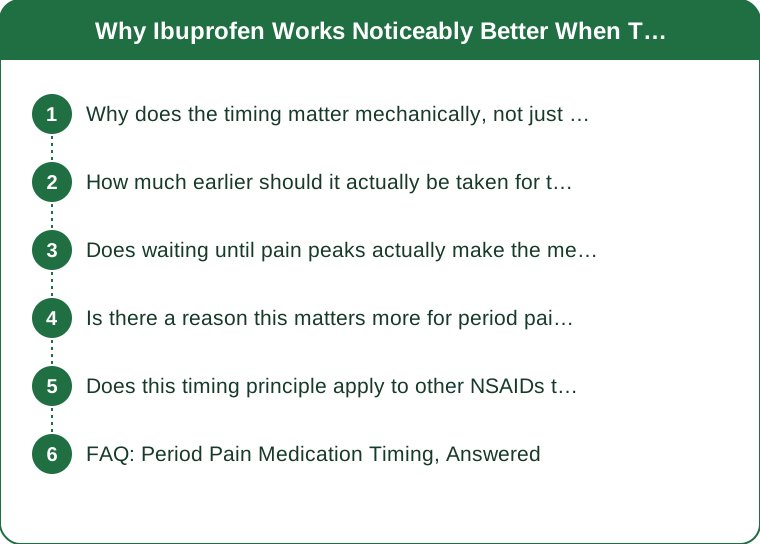
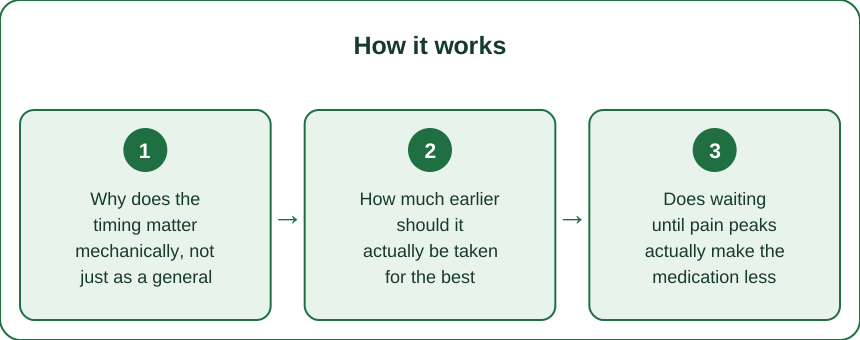
Why does the timing matter mechanically, not just as a general habit?
NSAIDs like ibuprofen work by inhibiting the enzyme (COX) responsible for producing new prostaglandins, the compounds that trigger uterine cramping — but they don’t neutralize prostaglandins that have already been released into the system before the medication takes effect. This means the medication is fundamentally preventive for future prostaglandin production, not a reversal of pain already underway from existing prostaglandins.
How much earlier should it actually be taken for the best effect?
Taking it at the very first sign of period onset, or even the day before if your cycle is predictable enough to anticipate, rather than waiting until cramping is already significant, is the timing most consistently recommended by gynecologic guidance — this gets ahead of the bulk of new prostaglandin production before it accumulates to a painful level.
Does waiting until pain peaks actually make the medication less effective, or just slower?
Both — once prostaglandin levels have already built up and pain has peaked, the medication still blocks further production, but it has more accumulated prostaglandin activity to work against, and there’s already a backlog of pain signal present. This generally means both a slower onset of relief and a less complete overall effect compared to proactive dosing.

Is there a reason this matters more for period pain specifically compared to other pain types?
Somewhat, yes — period cramping is driven by an active, ongoing production process (prostaglandin release tied to the uterine lining shedding) rather than a single pain event, unlike, say, a one-time injury. This ongoing-production characteristic is exactly what makes preventing new prostaglandin synthesis early more impactful than for pain types driven by a single triggering event.
Does this timing principle apply to other NSAIDs too, or is it specific to ibuprofen?
The mechanism applies to NSAIDs generally (naproxen, aspirin, and others that work through COX inhibition), since they share the same basic prostaglandin-blocking action — the proactive timing principle isn’t unique to ibuprofen specifically, though individual NSAIDs vary in onset speed and duration.
FAQ: Period Pain Medication Timing, Answered
Is it safe to take ibuprofen preventively before period pain even starts, if your cycle is predictable?
Many gynecologists support this approach for people with predictable cycles and no contraindications, but check with a doctor about appropriate dosing and any personal health considerations first.
Does taking it with food change how well the proactive timing works?
Taking NSAIDs with food is generally recommended to reduce stomach irritation, and it doesn’t meaningfully change the proactive-timing benefit described here.
If you missed the early window, is it still worth taking ibuprofen once pain has already peaked?
Yes — it will still block further prostaglandin production and provide some relief, just typically less complete and slower than if taken proactively.
This is general information, not medical advice — talk to a doctor about appropriate medication, dosing, and timing for your specific situation, especially if pain is severe or unmanaged by over-the-counter options.
TL;DR:
- Ibuprofen blocks new prostaglandin production but doesn’t neutralize prostaglandins already released
- Taking it at first sign of period onset works better than waiting for pain to peak
- Waiting means fighting an accumulated backlog rather than preventing it in the first place
- The proactive-timing principle applies to NSAIDs generally, not just ibuprofen specifically
The same pill works differently depending on when it’s taken — getting ahead of prostaglandin production, not catching up to it, is what makes the biggest difference.
Keep Reading
This article is for general informational purposes only and is not medical advice. Always consult a qualified health professional for guidance specific to you.