How to Actually Tell When Period Pain Has Crossed From Normal Into Something Worth Investigating
Quick Answer: “Some period pain is normal” is true and useless as a self-check, because normal covers a huge range. The three signals that actually matter: pain that stops you functioning, pain that doesn’t respond to appropriately dosed pain relief, and pain that’s gotten progressively worse over recent cycles. Track your own baseline — that’s what makes the comparison meaningful.
You’ve asked before and gotten the same answer: cramps are normal, some people just get them worse.
Which leaves you exactly where you started, wondering whether what you’re experiencing is the normal-bad or the something-is-wrong-bad, with no way to tell the difference.
This is general information, not medical advice.

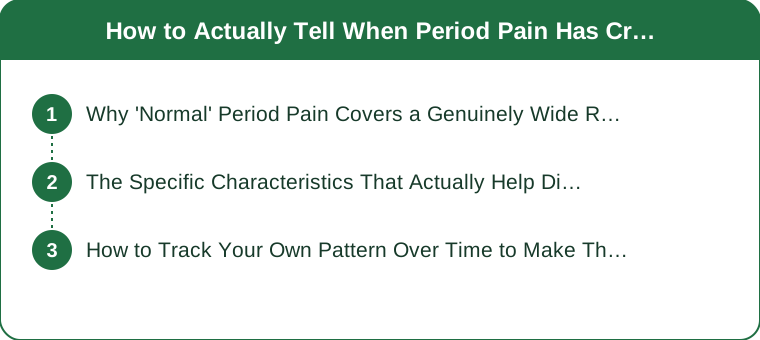
Why Is “Normal” Period Pain So Hard to Judge?
Because normal genuinely does cover a wide range, and there’s no fixed pain level that defines it for everyone.
Real differences in pain sensitivity and underlying physiology mean two people can describe identical experiences with completely different intensity, and both be within a normal range. So the population-level statement is accurate — it just can’t be applied to your individual case.
That’s why comparison to others fails you twice over. You can’t feel someone else’s cramps, and their threshold for describing pain isn’t yours. Friends who say “mine are fine” may have milder cramps, higher pain tolerance, or a habit of downplaying — and there’s no way to tell which.
Your own baseline is the useful comparator. How does this cycle compare to your cycles six months ago? A year ago? That’s a comparison you can actually make, and it’s the one that carries information about whether something has changed.
What Signals Actually Warrant Evaluation?
Three, and they’re more concrete than “how bad is it.”
1. Pain that significantly interferes with normal daily function. Not “uncomfortable” — genuinely unable to do what you’d otherwise do. Missing work or school, being unable to get out of bed, cancelling plans routinely. Functional impact is a far better measure than trying to rate pain on a 1–10 scale, because it’s observable rather than subjective.
2. Pain that doesn’t respond at all to appropriately dosed standard pain relief. The key words are appropriately dosed — taken at the right dose, at the right time, ideally starting before pain peaks. Pain that’s genuinely unmoved by that is different information than pain that improves partially.
3. Pain that has worsened progressively over several recent cycles. Change matters more than absolute level. Stable severe pain and worsening moderate pain are different situations, and the second one is often the more informative signal.
Also worth raising with a doctor, though slightly separate: pain outside your period, pain during sex, and unusually heavy bleeding. Those aren’t severity questions — they’re pattern questions, and they point somewhere specific.

What Nobody Tells You About Getting Period Pain Taken Seriously
Nobody tells you that “it’s normal” is sometimes a conversation-ender rather than a diagnosis. Conditions like endometriosis are known for long delays to diagnosis, frequently because severe pain was accepted as ordinary — by patients and clinicians both.
Nobody tells you that a written record changes the conversation. “It hurts a lot” invites reassurance. “I missed four work days in the last three cycles, ibuprofen at full dose does nothing, and it’s been getting worse since spring” invites investigation. Same experience, completely different clinical response.
Nobody tells you that you’re allowed to ask directly what’s being ruled out. It’s a reasonable question and it tends to shift the discussion productively.
And nobody tells you that timing your pain relief matters. Starting it before pain peaks — often a day before bleeding, if your cycle is predictable — works considerably better than chasing pain that’s already established. That’s worth knowing regardless of whether anything else is going on.
How Do You Track Your Own Pattern?
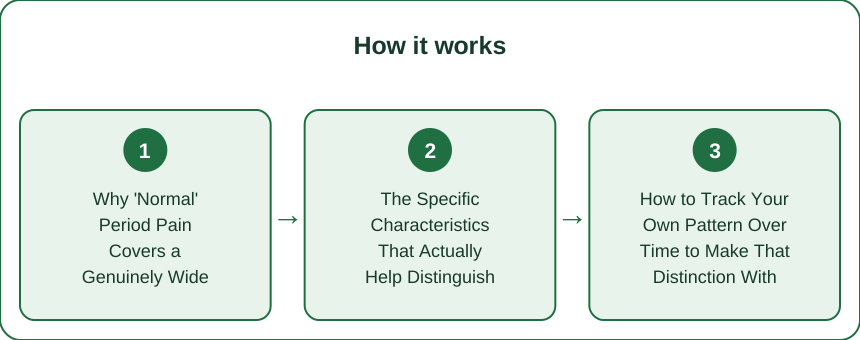
Simple and consistent beats detailed and abandoned. Over three to six cycles, record four things:
- Pain severity, on any scale you’ll actually use consistently
- Functional impact — what you couldn’t do. This is the most valuable field.
- Pain relief response — what you took, what dose, when, and whether it helped meaningfully
- Anything unusual — pain outside your period, unusually heavy bleeding, pain during sex
A notes app or a period-tracking app both work fine. The point is consistency, not sophistication.
After a few cycles you’ll have something you can’t get any other way: an actual trend line. Is severity stable or climbing? Does relief work reliably or not at all? Is functional impact worsening?
Then bring that record to an appointment if any of the three signals shows up. A tracked record supports a substantially more productive conversation than a recalled impression, and it makes a pattern visible that no single bad month would.
While tracking, the ordinary comfort measures are still worth using — heat, gentle movement, and clothing that doesn’t press on a tender abdomen. A lot of people find soft high waist leggings with a wide, non-digging waistband genuinely better than jeans on the worst days. That’s symptom management, not a substitute for evaluation.
When to see a professional: any of the three signals above, plus pain outside your period, pain during sex, or unusually heavy bleeding. Sudden severe pelvic pain that’s unlike your usual pattern needs prompt medical attention, not tracking. This is general information, not medical advice.
FAQ
How much period pain is too much?
There’s no universal number. The practical threshold is functional: if it regularly stops you doing normal activities, or doesn’t respond to appropriately dosed pain relief, that’s worth evaluating regardless of how it compares to anyone else.
What if my doctor says it’s normal and I disagree?
Bring your tracked record, describe the functional impact specifically, and ask what conditions are being ruled out. If you still feel unheard, seeking a second opinion is entirely reasonable.
How long should I track before making an appointment?
If a signal is clearly present, don’t wait — book now and track in the meantime. Three cycles of data is useful, but it isn’t a prerequisite for being seen.
TL;DR
- “Normal” covers a wide range, so population comparisons can’t answer your question. Your own baseline can.
- Three signals: significant functional interference, no response to appropriately dosed pain relief, and progressive worsening over recent cycles.
- Also flag pain outside your period, pain during sex, and unusually heavy bleeding.
- Track severity, functional impact, and relief response over three to six cycles.
- Bring the record to a doctor if a signal appears; seek prompt care for sudden severe pain.
Keep Reading
This article is for general informational purposes only and is not medical advice. Always consult a qualified health professional for guidance specific to you.