Why Coffee Makes Cramps Worse for Some People and Not Others
Quick Answer: Caffeine is a vasoconstrictor, which can reduce blood flow to the uterus and intensify cramping in people whose pain is driven by ischemia from strong contractions. In people whose discomfort is more bloating, fatigue, or headache-driven, caffeine often helps. That is why the advice splits so sharply, and a two-cycle test tells you which group you are in.
Half the internet says give up coffee during your period. The other half says caffeine helps the headache. Both are reporting accurate personal experience, and the mechanism explains why.

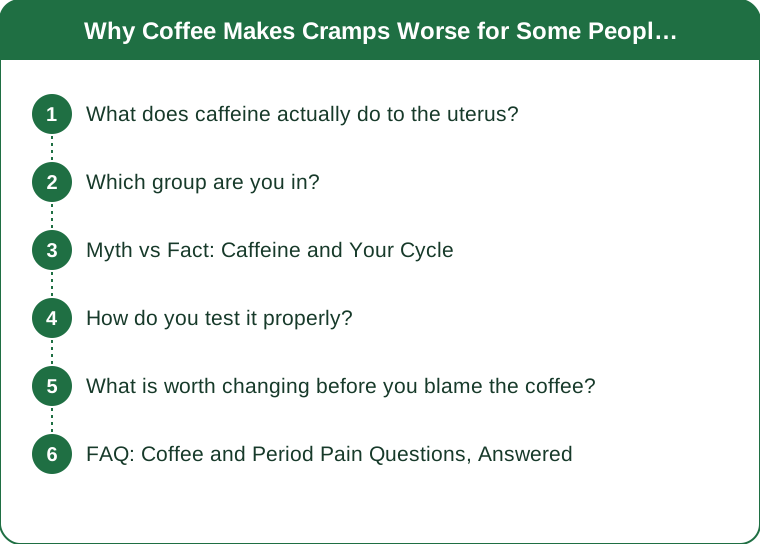
What does caffeine actually do to the uterus?
Two effects run in opposite directions, and which one dominates depends on your pain type.
Caffeine is a vasoconstrictor. It narrows blood vessels, which is precisely why it helps certain headaches and why it appears in some migraine medications. In the uterus, that same narrowing can reduce blood flow.
That matters because a significant part of menstrual cramping pain is ischemic. Prostaglandins drive strong uterine contractions, those contractions temporarily compress the vessels supplying the uterine muscle, and the resulting oxygen shortage produces pain. It is mechanically similar to why a cramping calf hurts.
Add vasoconstriction to a muscle already restricting its own blood supply and you can amplify the pain.
But caffeine also blocks adenosine, which reduces the fatigue and heaviness that accompany many cycles, and it relieves the caffeine-withdrawal headache that a person who skips their usual coffee will otherwise get. If your dominant symptom is exhaustion or headache rather than deep cramping, the net effect can be positive.
Which group are you in?
You can usually predict it from your symptom profile before testing.
Coffee likely makes it worse if: your pain is deep, cramping, and wave-like; it responds well to heat; NSAIDs help substantially; and your worst hours are the first day or two of bleeding. This profile is prostaglandin-driven contraction pain, which is exactly the mechanism caffeine can amplify.
Coffee likely helps or is neutral if: your dominant symptoms are fatigue, brain fog, low mood, or a dull headache; the cramping is mild; and you notice you feel worse on days you skip coffee generally.
It is complicated if: you get menstrual migraine. Caffeine can abort an early migraine and can also trigger a rebound headache later. Timing and dose matter more than presence or absence here, and this one genuinely benefits from a clinician’s input.
There is also a dose threshold. Many people who react badly to two or three cups do fine on one. The question is rarely coffee or no coffee.
Myth vs Fact: Caffeine and Your Cycle
Myth: Caffeine causes cramps. Fact: It does not cause them. Prostaglandins do. Caffeine can amplify existing contraction pain through vasoconstriction, which is a different and much narrower claim.
Myth: Quitting coffee during your period is safe and free. Fact: If you drink coffee daily, stopping abruptly on day one adds a withdrawal headache and fatigue to a day that is already difficult. Reducing gradually across the preceding two days is the version that actually helps.
Myth: Decaf solves it. Fact: For the vasoconstriction issue, largely yes. But coffee’s acidity and its effect on gut motility affect some people independently of caffeine, so switching to decaf and still feeling worse does not mean the coffee was innocent.
Myth: Tea is automatically gentler. Fact: A strong black tea can deliver half the caffeine of a coffee, and matcha can approach it. If you are testing the caffeine variable, count milligrams rather than beverages.
The one people find most useful: the effect is dose- and timing-dependent, not binary. One cup with food in the morning of day one is a completely different exposure from three cups on an empty stomach, and many people who thought they had to quit only needed to shift the timing.

How do you test it properly?
Two cycles, one variable, written down. It is unglamorous and it settles the question permanently.
Cycle 1: reduce. Taper to roughly half your usual caffeine starting two days before you expect to bleed, and hold that through day two. Tapering beforehand is what prevents withdrawal from contaminating the result.
Cycle 2: normal intake. Keep everything else the same, including sleep, heat use, and medication timing.
Rate pain 0-10 twice a day, morning and evening, on days one and two of each cycle. That is four numbers per cycle. Do not rate from memory at the end; the recall bias is large.
Also note what else changed, because the honest answer is often that sleep or stress moved more than caffeine did.
A difference of two or more points that repeats is a real signal. A difference of one point is noise. If you get a clear signal, the practical move is usually not abstinence but a smaller dose on the two heaviest days, with food.
This is general information, not medical advice. Pain that stops you functioning, requires increasing medication, or has changed noticeably from your normal pattern deserves a clinician’s assessment rather than a dietary experiment.
What is worth changing before you blame the coffee?
Three interventions with better evidence than caffeine restriction, and it is worth exhausting them first.
NSAID timing. Taking an anti-inflammatory before cramps establish, rather than after, works substantially better because it inhibits prostaglandin production rather than fighting prostaglandins already released. Starting the day before you expect to bleed, if your cycle is predictable, is the version most people have never tried.
Continuous heat. Sustained low heat applied for an hour or more compares favorably to oral analgesics in several studies. Intermittent heat for ten minutes does considerably less. The duration is the active ingredient.
Sleep the week before. Poor sleep lowers pain thresholds measurably. The nights before your period are often the worst-slept of the month, which means pain sensitivity is elevated before the pain even starts.
If all three are in place and coffee still makes a clear difference, then it is worth managing. If none of them are in place, coffee is unlikely to be your biggest lever.
FAQ: Coffee and Period Pain Questions, Answered
Does caffeine affect flow as well as pain?
Evidence is mixed and effects appear small. Most people who report a difference are noticing pain and cramping intensity rather than volume.
What about caffeine and PMS symptoms before bleeding starts?
This is a separate question with a clearer answer for many people: caffeine can worsen anxiety, breast tenderness, and sleep disruption in the luteal phase. Some people find reducing intake in the week before helps more than reducing it during.
Is there a best time of day to have coffee on a period day?
With food, and not first thing on an empty stomach. Coffee on an empty stomach increases gastric acid and gut motility, both of which compound the digestive symptoms that often accompany the first day.
TL;DR:
- Caffeine constricts blood vessels, which can worsen ischemic contraction pain but helps fatigue and headache
- Deep wave-like cramps that respond to heat point toward the group it makes worse
- Test across two cycles with a taper, rating pain twice daily, and change only the caffeine
- Fix NSAID timing, sustained heat, and sleep before blaming the coffee
The answer is personal and testable in two months. Until then, one cup with food on the heaviest days is the reasonable middle position.
Keep Reading
This article is for general informational purposes only and is not medical advice. Always consult a qualified health professional for guidance specific to you.