Why Cramps Hurt More After a Bad Night's Sleep
Quick Answer: Poor sleep measurably lowers pain thresholds - the same stimulus genuinely hurts more after a short or fragmented night. Sleep loss increases pain sensitivity, raises inflammatory signaling, and reduces the brain’s own pain-dampening capacity, so a cramp that would have been a 4 becomes a 7. The practical lever: protect sleep in the three or four nights before your period starts, not during it. Sleep also gets worse premenstrually, which makes the loop self-reinforcing unless you interrupt it early.
This is one of the few period-pain variables that is genuinely under your control.
This is general information, not medical advice.
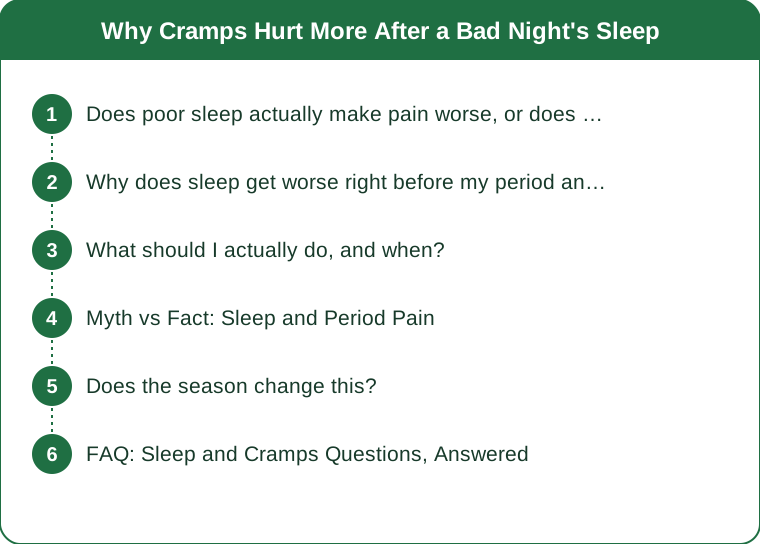
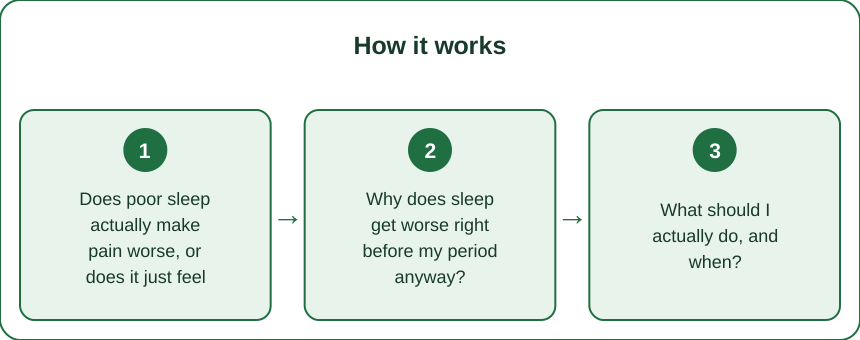
Does poor sleep actually make pain worse, or does it just feel that way?
It actually does, and the effect is larger than most people assume.
Experimental studies consistently show that sleep deprivation lowers pain thresholds. Deprive someone of sleep and apply the same stimulus, and they report more pain. This holds for partial sleep loss and for fragmented sleep, not just for full nights awake.
Three mechanisms are involved.
Reduced descending inhibition. Your brain actively dampens incoming pain signals through descending pathways. Sleep loss weakens that system, so more of the signal gets through.
Increased inflammatory signaling. Short sleep is associated with higher levels of inflammatory markers. Menstrual cramps are driven substantially by prostaglandins, which are inflammatory mediators - so a higher inflammatory baseline is a worse starting point.
Lower threshold for the emotional component. Pain has a sensory dimension and an unpleasantness dimension, and sleep loss affects the second one disproportionately. The cramp is not just stronger; it is harder to tolerate.
And the direction of the relationship is not symmetric. Research on sleep and pain generally finds that sleep loss predicts next-day pain more strongly than pain predicts that night’s sleep. Sleep is doing more of the causing.
Why does sleep get worse right before my period anyway?
Because the premenstrual phase changes several things that determine sleep quality.
Core body temperature is higher in the luteal phase. After ovulation, basal body temperature rises a few tenths of a degree and stays elevated until menstruation. Falling asleep requires core temperature to drop, so a higher baseline makes sleep onset harder and sleep lighter.
Progesterone falls sharply just before bleeding starts. Progesterone has sedative-like properties, and its withdrawal in the days before your period removes a sleep-supporting influence at exactly the wrong moment.
Physical symptoms interfere directly. Bloating, breast tenderness, and early cramping all fragment sleep.
So the loop: premenstrual hormonal changes worsen sleep, worse sleep lowers your pain threshold, and lower thresholds make the first day of bleeding hurt more. Each turn makes the next one worse.
The intervention point is upstream. Trying to fix sleep on day one, while cramping, is the hardest possible version. The nights that determine day-one pain are the three or four before it starts.
What should I actually do, and when?
Front-load everything. This is a scheduling problem more than a technique problem.
Days 3-4 before expected bleeding - protect sleep aggressively. Earlier bedtime, cooler room, no alcohol. This is the highest-leverage window and almost nobody uses it, because nothing hurts yet.
Keep the room cooler than usual - around 60-67°F. Your core temperature is already elevated in the luteal phase, so you need more environmental help than in the first half of your cycle.
Skip evening alcohol in that window. It fragments the second half of the night, which is where the sleep-loss effect on pain concentrates.
Watch caffeine timing rather than caffeine itself. Caffeine has a half-life of roughly five hours, so a 3 p.m. coffee is still meaningfully present at bedtime. Cutting off by early afternoon in the premenstrual week is a reasonable trade.
Start anti-inflammatory medication before pain begins, if you use it. NSAIDs work by blocking prostaglandin production rather than by removing prostaglandins already made. Taking them at the first sign - or the day before, if your cycle is predictable - is meaningfully more effective than taking them once cramps are established. Discuss with your doctor or pharmacist, especially with any stomach or kidney history.
And use heat early. A heating pad applied at the first twinge outperforms one applied at peak pain, for the same reason.
Myth vs Fact: Sleep and Period Pain
Myth: Pain is what wakes you up, so pain is the thing to fix. Fact: the relationship runs more strongly the other way. Sleep loss predicts next-day pain better than pain predicts that night’s sleep - so protecting sleep is the more effective lever.
Myth: Catching up on the weekend fixes it. Fact: recovery sleep helps, but it does not fully reverse the pain-sensitivity effect, and irregular sleep timing has its own costs. Consistency beats catch-up.
Myth: A nightcap helps you sleep through cramps. Fact: alcohol shortens sleep onset and then fragments the rest of the night. It reliably makes the following day’s pain worse, which is the opposite of the intended effect.
Myth: If you sleep enough hours, you are covered. Fact: fragmented sleep produces the pain-sensitivity effect even at normal total duration. Continuity matters as much as quantity - which is why a warm room and a late drink can undo an eight-hour night.
Myth: There is nothing to be done about premenstrual sleep changes. Fact: the temperature and timing levers are real and controllable. Cooler room, earlier bedtime, no alcohol in that window addresses a large share of it.
Does the season change this?
Yes - and late summer into fall shifts it twice.
Warm nights raise the whole system. In the luteal phase your core temperature is already up; a hot bedroom leaves you no margin. Late-summer premenstrual weeks are commonly the worst-sleeping ones of the year, and cooling the room is the fix that keeps paying.
Then the light changes fast. From late August, sunrise moves later week by week and circadian timing drifts, which fragments sleep for a few weeks until it stabilizes. If a fall cycle feels unusually rough, this is often part of it.
Morning light is the correction. Ten to fifteen minutes outside soon after waking anchors the rhythm and improves both sleep onset and continuity. It is free and the effect compounds over days.
Schedules also compress in September, cutting into the wind-down that the premenstrual week most needs. Put the protected nights in your calendar if your cycle is predictable - it is the only way they survive a busy month.
And cooler weather makes heat therapy more pleasant, which is a small but genuine advantage. A heating pad in August is a hard sell; in October it is easy, and early heat is more effective than late heat.
FAQ: Sleep and Cramps Questions, Answered
How much sleep loss is enough to matter?
Studies show measurable pain-threshold changes after even partial sleep restriction - a few hours short, not necessarily a full night. Two or three consecutive short nights is a realistic threshold for noticing it in daily life.
Should I nap if I slept badly before my period?
A short nap of 20-30 minutes early in the afternoon can help without disrupting that night’s sleep. Longer or later naps tend to push bedtime back, which restarts the problem.
When is period pain more than a sleep-quality problem?
If pain regularly stops you from working or going to school, if it is worsening over time, or if it does not respond to standard measures, that is worth investigating - conditions like endometriosis are common and frequently diagnosed late. This is general information, not medical advice; talk to your doctor.
TL;DR:
- Sleep loss genuinely lowers pain thresholds through reduced pain inhibition and higher inflammatory signaling.
- Premenstrual sleep is worse by design - higher core temperature and falling progesterone - which creates a self-reinforcing loop.
- Protect the three or four nights before bleeding starts, not the days during it.
- Cooler room, no evening alcohol, earlier caffeine cutoff in that window.
- Start heat and any anti-inflammatory early - both work better before prostaglandins accumulate.
Put the protected nights in your calendar for next cycle. It is the intervention that costs the least and the one nobody thinks to make while nothing hurts. This is general information, not medical advice.
Keep Reading
This article is for general informational purposes only and is not medical advice. Always consult a qualified health professional for guidance specific to you.