Why Heat Relieves Period Pain, But Only at the Right Temperature
Quick Answer: Heat relieves menstrual cramps by increasing local blood flow, relaxing uterine smooth muscle, and activating heat-sensitive receptors that reduce pain signal transmission. The effective range is roughly 104 to 113 degrees Fahrenheit applied continuously — comfortably warm, not hot. Higher temperatures do not increase relief and cause skin desensitization, which is why the pad seems to stop working. Continuous low heat outperforms intermittent high heat by a wide margin.
Heat is one of the few non-drug interventions for period pain with genuine evidence behind it. It just needs to be applied correctly, which most people are not told how to do.
This is general information, not medical advice.

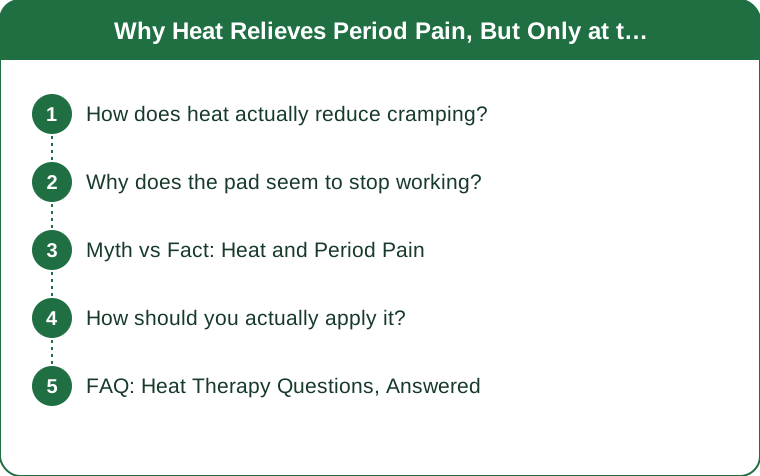
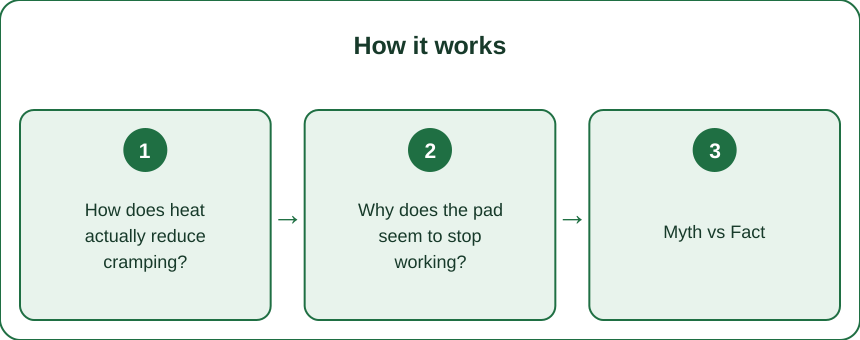
How does heat actually reduce cramping?
Through three distinct mechanisms that operate on different timescales.
Smooth muscle relaxation. Menstrual cramps are uterine muscle contractions driven by prostaglandins. Warmth applied to the abdomen increases local tissue temperature enough to reduce smooth muscle tone, which directly lessens contraction intensity. This takes 15 to 20 minutes to develop fully.
Increased blood flow. Part of cramp pain is ischemic — contraction restricts blood flow to the uterine muscle, and the resulting oxygen shortage produces pain in much the same way it does in any working muscle. Heat causes vasodilation, which improves perfusion and interrupts that cycle. This is fast, within a few minutes.
Receptor-level pain modulation. Heat activates TRPV1 receptors, and there is good evidence that sustained heat activation reduces transmission of pain signals at the spinal level — a gating effect not unlike why rubbing a bumped elbow helps.
The third mechanism is the one that explains the temperature ceiling. TRPV1 activation is not linear with temperature, and the receptors adapt with continued stimulation. What matters more is continuity than intensity, which is exactly the opposite of how most people use a heating pad.
Why does the pad seem to stop working?
Because of adaptation, and because people respond to adaptation by escalating.
Skin thermoreceptors adapt rapidly to a constant stimulus. Within 10 to 15 minutes, a temperature that felt distinctly warm feels merely present. This is a sensory change, not a loss of therapeutic effect — the tissue is still being warmed and the muscle relaxation is still happening.
But it does not feel like it is working, so the natural response is to turn it up. Higher heat produces a brief renewed sensation, which adapts again, which prompts another increase. Within an hour people are running a pad at a setting that risks a low-temperature burn while getting no more therapeutic benefit than they had at the start.
Low-temperature contact burns are a genuine risk, and they occur at temperatures well below what feels dangerous — sustained contact around 110 to 115 degrees Fahrenheit for an hour or more can damage skin, particularly in someone who has fallen asleep or whose skin has been desensitized by the adaptation described above.
The correct response to the sensation fading is to leave it alone. If you want to restore the sensation, briefly remove the pad for two to three minutes and reapply. The receptors reset and the perceived warmth returns without any temperature increase.
Additionally: heat applied over clothing is safer and nearly as effective as direct skin contact, because the fabric layer buffers the peak temperature while still transmitting sustained warmth.

Myth vs Fact: Heat and Period Pain
Myth: Hotter works better. Fact: Studies comparing continuous low-level heat to higher intermittent heat consistently favour the continuous low-level version. The therapeutic window is roughly 104 to 113 degrees Fahrenheit, and above that you gain risk without gaining relief.
Myth: Heat is a weak alternative to medication. Fact: Continuous low-level heat has been shown in trials to compare favourably with common over-the-counter analgesics for menstrual pain, and the two together tend to work better than either alone.
Myth: A hot bath is equivalent to a heat pad. Fact: A bath is pleasant and does relax muscles broadly, but it cannot be sustained for hours and the whole-body vasodilation can leave you lightheaded. For targeted, sustained relief, a wearable pad or patch is more practical.
Myth: Cold works just as well for some people. Fact: Cold reduces inflammation and numbs, which helps some kinds of pain, but it increases smooth muscle tone — the opposite of what a cramping uterus needs. Anecdotally some people prefer it; mechanistically heat has the stronger case.
Myth: Where you put it does not matter much. Fact: Lower abdomen is standard, but many people get more relief from placement on the lower back, and cramps that refer to the back respond better there. Trying both placements on different cycles is worth the experiment.
How should you actually apply it?
Four rules, all of them boring and all of them the difference between it working and not.
Start early, before the pain peaks. Applying heat at the first sign of cramping is considerably more effective than applying it once pain is established. Pain that has escalated is harder to reduce than pain that is prevented from escalating.
Aim for continuous, not intermittent. Adhesive heat patches designed for eight hours of low-level warmth are the most practical way to achieve this, because they can be worn under clothing during a normal day. A plug-in pad works at home but tends to produce the escalation cycle described above.
Set it comfortably warm, then leave it. If it feels hot, it is too hot. If the sensation fades after 15 minutes, that is expected — remove for two minutes and reapply rather than increasing the setting.
Never sleep on a plug-in pad. This is where low-temperature burns actually happen. If you want overnight relief, use a patch rated for it or a wheat bag that cools passively.
A reasonable protocol: apply at the first twinge, continuous low warmth for two to four hours, brief removal every hour to reset the sensation, combined with gentle movement — walking, easy stretching — which adds a separate blood-flow benefit that heat alone does not provide.
And note when heat is not enough. Pain that stops you from working or from your normal activities, pain that has changed in character, or pain that does not respond to standard measures is worth seeing a clinician about. Severe dysmenorrhea has treatable underlying causes including endometriosis and fibroids, and heat is symptom management rather than an answer.
FAQ: Heat Therapy Questions, Answered
How long before it starts working?
Some relief in the first five minutes from the blood flow effect, with full effect at 15 to 20 minutes as tissue temperature reaches the working range. If you have felt nothing at 30 minutes, the temperature is likely too low or the placement is off.
Can I use heat with pain medication?
Generally yes, and the combination often works better than either alone — though check with a pharmacist regarding your specific medications. The mechanisms are different, so the effects add rather than overlap.
Do heat patches lose effectiveness over a long day?
Air-activated patches produce a fairly stable output for their rated duration and then decline. A single patch replaced once mid-day covers most working days better than one worn until it is fully spent.
This is general information, not medical advice. See a clinician about period pain that is severe, worsening, or interfering with daily life.
TL;DR:
- Heat works through muscle relaxation, improved blood flow, and pain signal gating.
- The effective range is about 104 to 113 degrees Fahrenheit; hotter adds risk, not relief.
- Sensation fading after 15 minutes is receptor adaptation, not loss of effect — remove briefly and reapply instead of turning it up.
- Start at the first twinge, aim for continuous low warmth, and never sleep on a plug-in pad.
Next cycle, apply heat before the pain builds rather than after, and resist every urge to increase the setting. Most people find it works better at a lower temperature than they have been using.
This is general information, not medical advice.
Keep Reading
This article is for general informational purposes only and is not medical advice. Always consult a qualified health professional for guidance specific to you.