Why Heat Works Better on Your Lower Back Than Your Abdomen
Quick Answer: Uterine pain is carried by nerves that enter the spinal cord at the T10 to L1 levels, which map to the skin of your lower back as much as your lower abdomen. Heat on the lower back can reach the same pain pathway while also relaxing the muscles that tighten in response to cramping, which is why many people get more relief there.
You have been putting the heating pad on your stomach since you were thirteen, because that is where it hurts. It helps, somewhat. Try it on your lower back for one cycle and a meaningful number of people find it works better, and the reason is anatomical rather than mysterious.

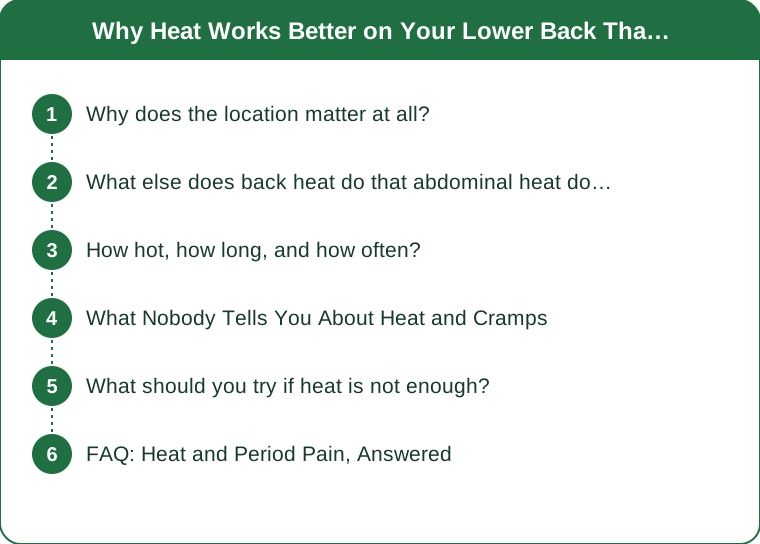
Why does the location matter at all?
Because of referred pain, and specifically how the uterus is wired.
Sensory nerves from the uterus enter the spinal cord at roughly the T10 through L1 levels. Those same spinal levels also receive sensation from a band of skin that wraps around your lower abdomen, hips, and lower back.
The brain cannot always distinguish which structure a signal came from once it arrives at a shared level. That is why menstrual pain is felt in the low back and upper thighs at all — the uterus is not there, but the wiring is.
The useful implication runs in reverse. Warming the skin over those spinal levels sends competing sensory input into the same segment, which can dampen the pain signal via the gate control mechanism. And the back has an advantage: less soft tissue between the skin and the relevant structures than the front does in many people.
What else does back heat do that abdominal heat does not?
It addresses the secondary problem — muscle guarding.
When the uterus cramps, the surrounding musculature responds. The lumbar paraspinals, the quadratus lumborum, and often the hip flexors and pelvic floor all increase their resting tension. That tension produces its own pain, on top of the cramping, and it can outlast the cramp itself.
Heat applied to the low back reduces that muscular guarding directly. It increases local blood flow, decreases muscle spindle sensitivity, and makes it physically easier to relax.
Many people describe the difference as abdominal heat feeling soothing while back heat feels like something actually loosens. Both are legitimate; they are working on different components of the same problem.
The best answer for a lot of people is both, alternating, or a wrap that covers front and back simultaneously.
How hot, how long, and how often?
Specifics matter more here than most people realize.
Temperature: around 104°F, which is warm and comfortable rather than hot. Research on continuous low-level heat therapy uses temperatures in this range, and there is no benefit to going hotter — just a burn risk, particularly with adhesive patches worn under clothing.
Duration: continuous low-level heat for several hours outperforms short intense applications. Studies comparing heat wraps with common pain relievers have found comparable relief from sustained heat.
Timing: starting heat before the worst of the cramping, ideally at the first sign, works better than waiting for peak pain. Same principle as pain medication.
Safety: never sleep on a plugged-in heating pad, always keep a layer of fabric between an adhesive heat patch and bare skin, and if you have reduced sensation in an area, do not use heat there at all. This is general information, not medical advice.

What Nobody Tells You About Heat and Cramps
A few details that change results noticeably.
Position changes what heat can reach. Lying on your back with a pad underneath compresses the tissue and reduces circulation to the area you are trying to warm. Lying on your side or front with the pad against your low back allows better blood flow, and blood flow is part of the mechanism.
A warm bath beats a heating pad for widespread relief because it warms the hip and thigh referral zones at the same time, but a wearable wrap beats both for practicality, since you can keep it on for six hours while living your life.
Heat plus gentle movement outperforms heat alone. Ten minutes of walking or a few minutes of a supported child’s pose while warm gives better results than heat while completely still.
Cold helps a minority of people. If heat has never worked well for you, a cool pack on the low back is worth one trial. Pain modulation is individual, and a small subset genuinely prefers it.
What should you try if heat is not enough?
Heat is a first-line tool, not the whole toolkit. Reasonable additions:
- NSAIDs taken early, ideally at the first sign of symptoms rather than at peak pain, work by reducing the prostaglandins that drive uterine contraction. Timing matters more than dose for most people.
- Movement, particularly walking and gentle hip-opening positions, which improves pelvic blood flow
- TENS units, which use the same gate control principle as heat via a different input
- Magnesium and consistent sleep, both of which have modest but real support for cramp severity
When to see a clinician rather than manage at home: pain that stops you from working or attending school, pain that has changed character or gotten worse over recent cycles, pain that does not respond to NSAIDs, or bleeding heavy enough to soak through protection hourly. Those can indicate endometriosis, fibroids, or adenomyosis, all of which are common, underdiagnosed, and treatable.
FAQ: Heat and Period Pain, Answered
Does a hot water bottle work as well as an electric pad?
For short use, yes. The disadvantage is that it cools over 30 to 60 minutes, and the evidence favors sustained heat over several hours. Adhesive heat patches are the most practical option for continuous use.
Can I use heat and pain medication together?
Generally yes, and they work through different mechanisms so the combination is often more effective than either alone. Check with a pharmacist about your specific medications.
Why does heat sometimes make bloating feel worse?
Heat increases local blood flow and can increase the sensation of fullness. If that is your experience, try the low back rather than the abdomen — it is one of the clearest cases where switching location helps.
TL;DR:
- Uterine pain shares spinal levels with the skin of your lower back, so heat there reaches the same pathway
- Back heat also reduces the muscle guarding that abdominal heat does not address
- Aim for around 104°F, sustained for hours, started at the first sign rather than at peak pain
- Pair heat with gentle movement, and see a clinician if pain stops you from functioning
The reason this is worth one experiment is that it costs nothing and takes one cycle to test. Put the pad where you have always put it on day one, move it to your low back on day two, and see which one you reach for by instinct next month. A surprising number of people never go back to the front.
Keep Reading
This article is for general informational purposes only and is not medical advice. Always consult a qualified health professional for guidance specific to you.