Why Period Cramps Feel Worse in the Morning Than the Evening
Quick Answer: Overnight you are still, cold, and lying flat, so pelvic circulation is at its lowest and muscles are at their stiffest. Prostaglandin activity and uterine contractions continue regardless. You also wake with an empty stomach and no pain relief on board from the previous evening. The combination means the same level of cramping is experienced more intensely in the first two hours after waking.
You go to bed with cramps that are annoying. You wake up with cramps that are genuinely difficult, and by lunchtime they are back to annoying again.
The pattern is common enough that it is worth explaining properly, because most of the contributing factors are things you can do something about the night before.

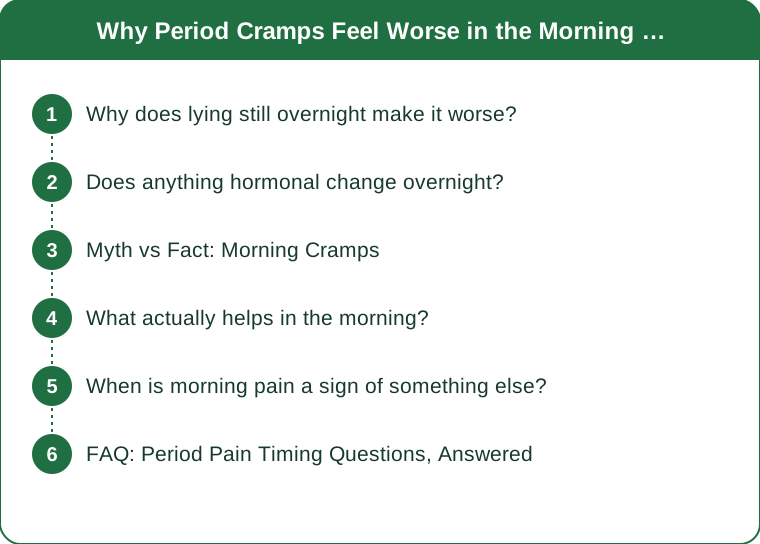
Why does lying still overnight make it worse?
Because circulation and movement are two of the main things that modulate cramping pain, and both are absent for eight hours.
Uterine cramping is partly an ischaemic pain. Contractions of the uterine muscle compress the vessels running through it, briefly restricting blood flow. Reduced flow in a contracting muscle is a well-recognised source of pain — the same basic mechanism that makes a muscle cramp in your calf hurt.
Anything that improves pelvic blood flow reduces that pain, which is why walking, heat, and movement all help. Lying still for eight hours does the opposite.
Position matters too. Lying flat gives no gravitational assistance to pelvic circulation and holds the hip flexors in a shortened position for hours. Those muscles attach to the lumbar spine and pelvis, and shortened hip flexors contribute to the lower back component that many people experience alongside abdominal cramping.
Core temperature falls overnight. Body temperature reaches its lowest point in the early hours, typically a couple of hours before waking, and cold increases muscle tension and reduces tissue compliance. This is the same reason cramps feel worse in a cold room — you have essentially spent the night in a cooler version of yourself.
And nothing has been interrupting it. During the day you shift position, stand up, walk to the kitchen. Each of those provides brief relief. Overnight there is no interruption at all.
Does anything hormonal change overnight?
The underlying process continues, and one contributor is genuinely time-related.
Prostaglandins drive the contractions. These are inflammatory mediators released as the uterine lining breaks down, and they are what make the uterus contract strongly. Higher prostaglandin levels correlate with more painful periods. This process runs continuously — it does not pause overnight.
Cortisol has a strong daily rhythm, rising sharply in the hour or so around waking. Cortisol is broadly anti-inflammatory, so the very early hours before that rise are a period of relatively lower endogenous anti-inflammatory activity.
Pain perception itself varies across the day. Pain thresholds are not constant, and many pain conditions show a morning peak. Some of the morning experience is genuinely about how pain is processed rather than about how much tissue signal there is.
And there is a practical factor that is easy to overlook: whatever pain relief you took in the evening has largely worn off. Most common analgesics have a duration of action of four to eight hours. If you took ibuprofen at 10pm, there is essentially none on board at 7am, which means you are waking into unopposed cramping.
That last point is the most actionable thing in this article.
Myth vs Fact: Morning Cramps
Myth: it is worse in the morning because you are tired. Fact: poor sleep genuinely lowers pain tolerance and is a real contributor. But the morning peak occurs even after a good night’s sleep, because circulation, temperature, and medication timing all point the same way.
Myth: staying in bed will help. Fact: it prolongs exactly the conditions that made it worse. Gentle movement improves pelvic blood flow, and most people find cramps ease measurably within twenty minutes of getting up and moving — even though the first five minutes feel like a mistake.
Myth: you should wait until the pain is bad before taking anything. Fact: this is backwards for period pain specifically. Anti-inflammatory pain relief works by reducing prostaglandin production, so it is far more effective taken before or at the very start of pain than after it is established. Waiting until it is severe means playing catch-up against prostaglandins that are already circulating.
Myth: heat only works on the abdomen. Fact: heat on the lower back is at least as effective for many people, and for morning stiffness it addresses the lumbar and hip flexor component that lying flat overnight produces.
Myth: severe cramps are just something to put up with. Fact: pain that stops you doing normal activities, does not respond to standard pain relief, or has changed noticeably from your baseline is worth investigating rather than enduring.

What actually helps in the morning?
Plan the night before, then move deliberately in the first thirty minutes.
The night before:
- Take anti-inflammatory pain relief timed to cover the early morning rather than at bedtime, following the dosing instructions on the packet. This is the single highest-impact change available and it is why so many people find mornings hard — the timing is simply wrong.
- Keep the room slightly warmer than usual, or add a layer. Cold amplifies everything here.
- Sleep on your side with a pillow between your knees rather than flat. It reduces the hip flexor shortening and many people find it eases the lower back component.
- Hydrate in the evening. Dehydration meaningfully worsens cramping, and you wake dehydrated after eight hours regardless.
The first thirty minutes after waking:
- Heat first, before you get up. A heating pad on the lower abdomen or lower back for ten minutes at a comfortably warm — not hot — temperature. Heat has genuine evidence for period pain and it works fastest when applied before you start moving.
- Take pain relief with something to eat, not on an empty stomach. Anti-inflammatories on an empty stomach are both harder on the stomach and often slower to act.
- Move gently for ten minutes. Walking around the house is enough. Knees-to-chest and a gentle cat-cow both address the lumbar component directly.
- Warm drink. Partly hydration, partly the internal heat, partly that it gets you upright.
What to avoid in the first hour: sitting hunched, which increases the lower back component; caffeine on an empty stomach, which worsens cramps for some people; and staying flat in bed hoping it passes.
This is general information, not medical advice.
When is morning pain a sign of something else?
Most of the time this is ordinary primary dysmenorrhoea with a daily rhythm. Some patterns deserve a proper look.
Worth discussing with a clinician:
- Pain that has become significantly worse over recent cycles rather than being stable
- Pain that starts several days before bleeding and continues after it stops
- Pain that does not respond to standard over-the-counter anti-inflammatories taken correctly and on time
- Pain that regularly stops you working, studying, or getting out of bed
- Pain with bowel or bladder symptoms, pain with intercourse, or pain that is one-sided and severe
- Heavy bleeding alongside the pain, particularly if you are tired or breathless — iron deficiency both results from heavy periods and independently worsens pain perception
The iron point deserves emphasis because it is common and easily missed. Low ferritin produces fatigue, lowers pain tolerance, and is frequently present in people with heavy periods. It is a simple blood test and it is worth asking for if this describes you.
On timing of care: period pain that is genuinely disabling is often normalised for years before anyone investigates it, and conditions such as endometriosis are commonly diagnosed late for exactly that reason. Severity that interferes with your life is a sufficient reason to be assessed — you do not need to justify it further.
This is general information, not medical advice.
FAQ: Period Pain Timing Questions, Answered
How hot should a heating pad be?
Comfortably warm rather than hot — warm enough to feel clearly, not enough to redden the skin. Higher temperatures do not work better and carry a burn risk, particularly if you fall asleep with it on. Use a pad with an auto-off if you are using it in bed.
Should I exercise on a bad cramp morning?
Gentle movement almost always helps. Hard training is a different question and depends on how you feel — many people find moderate exercise reduces cramps, and there is no reason to avoid it if it feels manageable. Judge it session by session rather than by rule.
Why does day two hurt differently than day one?
Prostaglandin release is typically highest in the first 48 hours, which is why the first two days are usually the worst. The quality of the pain often changes as bleeding progresses, and many people find day two is more of a deep ache while day one is sharper cramping.
Does the morning pattern change with age?
It can. Period pain characteristics often shift through the thirties and forties, and a clear change in pattern — particularly worsening — is worth mentioning to a clinician rather than assuming it is just age.
TL;DR: Mornings stack the deck against you, and most of it is fixable the night before.
- Eight hours of stillness means pelvic circulation at its lowest and muscles at their stiffest, while contractions continue regardless.
- Core temperature bottoms out in the early hours, and cold amplifies cramping.
- Whatever you took at 10pm has worn off by 7am — this is the single biggest and most fixable factor.
- Anti-inflammatories work by reducing prostaglandin production, so timing them before pain establishes matters more than the dose.
- First thirty minutes: heat before getting up, pain relief with food, ten minutes of gentle movement, warm drink.
Sleep on your side with a pillow between your knees and keep the room warm. If pain is severe, worsening, or unresponsive to standard relief, get it looked at rather than timed around.
Keep Reading
This article is for general informational purposes only and is not medical advice. Always consult a qualified health professional for guidance specific to you.