Why Period Cramps Feel Worse the Day After a Hard Workout
Quick Answer: A hard session the day before your period can worsen cramps through three routes: inflammatory signaling from muscle damage adds to prostaglandin-driven pain, dehydration and electrolyte loss increase muscle cramping generally, and abdominal loading can heighten pelvic tension. Moderate exercise reliably helps cramps; maximal effort in the two days before your period sometimes does not.
You know exercise helps your cramps. You have felt it. So the day before your period you did a hard session, and day one was worse than usual.
Both things are true. Regular moderate exercise is one of the better-supported non-drug approaches to menstrual pain. A single maximal session at the wrong moment can still make a specific day worse.
Here is why, and how to time it.
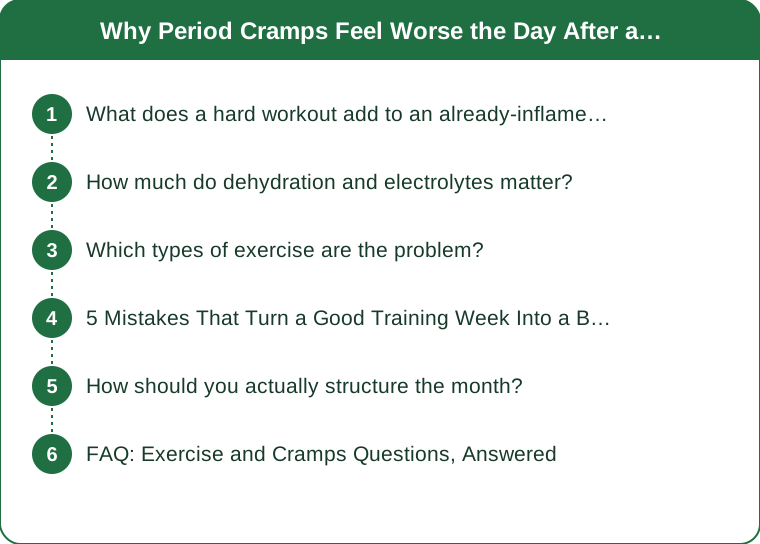
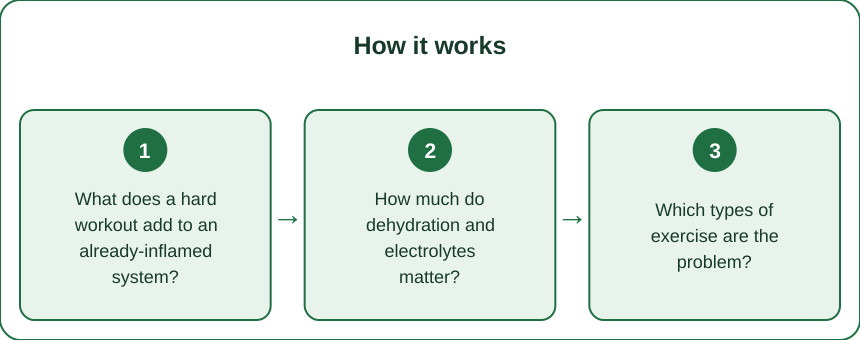
What does a hard workout add to an already-inflamed system?
Menstrual cramps are driven substantially by prostaglandins — inflammatory mediators released as the uterine lining breaks down. They cause the uterine muscle to contract, and at higher levels they cause the contractions to be stronger and more painful.
Intense exercise produces its own inflammatory response. Muscle damage from hard or unaccustomed work triggers a systemic inflammatory cascade that peaks roughly 24 to 48 hours later — the same window as delayed onset muscle soreness.
Line those two curves up and you have a day where you are dealing with both at once. The inflammation is additive, and your overall pain sensitivity is higher when systemic inflammation is elevated.
This also explains a detail people find confusing: it is specifically the day after the hard session that is bad, not the session itself. During exercise, endorphins and increased pelvic blood flow usually make cramps feel better. The bill arrives a day later.
How much do dehydration and electrolytes matter?
More than most people account for, and it is the most easily fixed factor here.
A hard session loses fluid and sodium. Dehydration is associated with more muscle cramping generally, and the uterus is a muscle. Low magnesium and potassium are similarly associated with increased cramping.
There is a compounding factor: many people naturally drink less in the days before their period because of bloating, on the theory that less fluid means less bloat. It does not work that way — mild dehydration tends to make the body retain more.
Practical steps for the 48 hours around a hard session near your period:
- Drink more than you feel like. Aim for consistent intake rather than a large amount at once.
- Replace sodium if the session was long or sweaty. A proper electrolyte drink, or just salted food.
- Magnesium is worth considering. Magnesium supplementation has modest support for menstrual cramp relief, and dietary sources — leafy greens, nuts, seeds, dark chocolate — are easy to increase. Check with your doctor before adding supplements.
None of this is dramatic. It reliably takes the edge off the worst version of a bad day.
Which types of exercise are the problem?
Not all hard sessions are equal here, and the differences are usable.
Most likely to aggravate:
- Heavy loaded abdominal and hip work — heavy squats, deadlifts, weighted core work. These increase intra-abdominal pressure and pelvic muscle tension directly.
- High-impact plyometrics — repeated jarring impact on an already-sensitive pelvis.
- Maximal-effort intervals — the largest inflammatory and stress-hormone response for a given amount of time.
- Very long endurance sessions — the biggest fluid and electrolyte losses.
Least likely to aggravate, and often actively helpful:
- Steady moderate cardio — walking, easy cycling, easy swimming. Increases pelvic blood flow without a big inflammatory cost.
- Yoga and mobility work. Several specific poses are commonly reported to relieve cramping, and the breathing component reduces pelvic tension.
- Light to moderate strength work at submaximal loads.
The practical rule: in the two days before your period, keep training but cap the intensity. You lose very little fitness from two moderate sessions, and you may save yourself a genuinely bad day one.

5 Mistakes That Turn a Good Training Week Into a Bad Period
1. Scheduling your hardest session for the day before you expect to start. The most common version of this problem, and the easiest to fix — just look at your tracker before you plan the week.
2. Under-eating around hard sessions in the luteal phase. Energy needs are slightly higher in the luteal phase, and under-fueling raises cortisol and pain sensitivity. This is not the week to combine a deficit with hard training.
3. Skipping the cool-down. Going straight from maximal effort to sitting leaves you tight and pooled. Five minutes of easy movement and some hip-opening stretches genuinely helps.
4. Cutting fluids to control bloating. It backfires — mild dehydration increases retention and increases cramping.
5. Stopping exercise entirely during your period. The evidence points the other way: regular moderate activity is associated with less menstrual pain over time. Reduce the intensity, not the habit.
How should you actually structure the month?
Cycle-aware training is not complicated, and this is the practical version.
Follicular phase (after your period through ovulation): Generally the best window for hard work. Rising estrogen, better recovery, higher tolerance for intensity. Put your heaviest and hardest sessions here.
Around ovulation: Often peak strength and energy. Good for a personal best attempt if you want one.
Early luteal: Still good for solid training. Slightly higher body temperature and perceived effort — hot sessions feel harder.
Late luteal (the 3-5 days before your period): Dial intensity back. Keep the frequency, reduce the load. Moderate cardio, technique work, mobility.
Menstrual phase: Follow your symptoms rather than a rule. Many people feel surprisingly good after day two and can train normally. Gentle movement on the worst day usually helps more than complete rest.
The key point: you are shifting when the hard work happens, not doing less of it. Over a month the total is the same, and the bad days are noticeably better.
FAQ: Exercise and Cramps Questions, Answered
Should I skip working out entirely during my period?
Generally no. Regular exercise is associated with reduced menstrual pain, and gentle movement on a cramping day increases pelvic blood flow and often provides real relief. What is worth skipping is maximal effort on your worst day — that is a rest or easy day, not a nothing day.
Does this mean I should not lift heavy at all in the luteal phase?
Not at all. It means the two or three days immediately before your period are a poor time for a maximal attempt or a brutal new stimulus. Normal working sets are fine. If you consistently feel strong in that window, follow how you actually feel over any general rule.
When is period pain a reason to see a doctor?
If pain regularly stops you doing normal activities, does not respond to over-the-counter medication taken properly, is getting worse over time, comes with very heavy bleeding, or is accompanied by pain during intercourse or bowel movements. Those patterns can indicate endometriosis or other conditions that are worth investigating. This is general information, not medical advice.
TL;DR:
- Hard exercise creates its own inflammatory response that peaks 24-48 hours later — right on top of prostaglandin-driven cramps.
- Dehydration and low electrolytes worsen muscle cramping, and people often drink less before their period.
- Heavy loaded core work, plyometrics, and maximal intervals are the biggest offenders; steady cardio and yoga usually help.
- Cap the intensity in the two or three days before your period, but keep the habit.
- Put your hardest work in the follicular phase and the month evens out with better bad days.
Exercise is still one of the best things you can do for cramps. The trick is putting the hard version somewhere other than the day before.
Keep Reading
This article is for general informational purposes only and is not medical advice. Always consult a qualified health professional for guidance specific to you.