Why Period Pain Feels Worse When Your Iron Is Low
Quick Answer: Low iron does not directly cause cramps, but it lowers your capacity to cope with them - reducing oxygen delivery to tissue, worsening fatigue, amplifying pain perception, and often causing headaches and dizziness during the exact days you are already struggling. Heavy periods are also the most common cause of iron deficiency in menstruating women, which makes it self-reinforcing. Testing ferritin, not just haemoglobin, is the step most often missed.
And this is a genuinely fixable contributor, which is why it is worth pursuing rather than accepting.

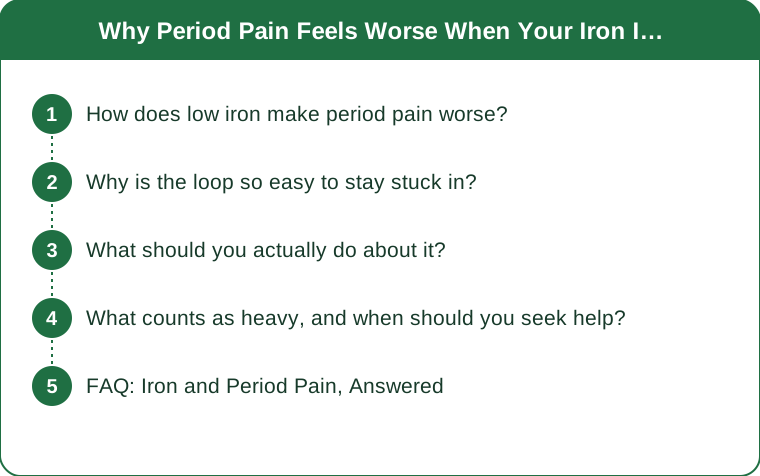
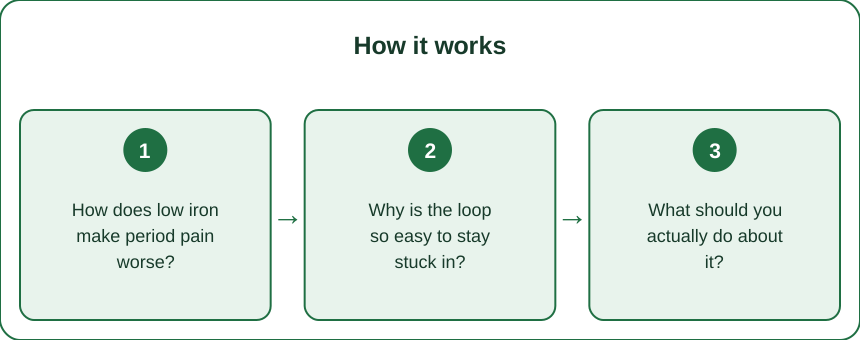
How does low iron make period pain worse?
Through several routes, none of which are the cramping mechanism itself.
Oxygen delivery drops. Iron is central to haemoglobin, which carries oxygen. Less iron means less oxygen reaching tissue, including the uterine muscle that is contracting hard during a period. Muscle working with reduced oxygen availability produces more discomfort for the same work.
Fatigue lowers pain tolerance. This is well established generally - tired people report the same painful stimulus as more painful. Iron deficiency fatigue is profound and specific, and it lands during the days pain is highest.
Poor sleep compounds it. Iron deficiency is associated with restless legs and disrupted sleep, and poor sleep independently increases pain sensitivity the following day. The loop tightens.
Headaches and dizziness add to the load. Both are common iron deficiency symptoms and both are commonly attributed entirely to hormones. Having three symptoms at once is harder to cope with than having one, even if the third is unrelated to the cramping.
And there is a plausible link in the other direction. Some evidence suggests iron deficiency may affect pain modulation pathways directly. The picture is not fully settled, but the practical implication is the same - correcting deficiency makes the experience more tolerable.
Why is the loop so easy to stay stuck in?
Because each part disguises the other.
Heavy periods are the most common cause of iron deficiency in menstruating women - and heavy is routinely underestimated. Many women have no comparison point and assume their experience is typical. Losing enough blood monthly to outpace dietary replacement is common and often unrecognised.
The symptoms are attributed to the period. Fatigue, headaches, feeling cold, poor concentration, breathlessness on stairs - all are read as period symptoms or as ordinary tiredness, so the underlying deficiency goes unexamined for years.
Standard blood tests can miss it. A full blood count measures haemoglobin, which stays normal until iron stores are substantially depleted. You can be significantly iron deficient with a normal haemoglobin - the marker that catches it earlier is ferritin, and it is not always included by default. Asking for it specifically is often necessary.
Diet alone rarely closes an established gap. If losses exceed absorption monthly, eating more spinach does not resolve a deficit that took two years to build. Correction usually requires supplementation, and that is a decision to make with a doctor rather than a supermarket.
And there is a timing trap. Testing immediately after a heavy period gives a different picture than testing mid-cycle. Worth mentioning to whoever orders the test.

What should you actually do about it?
Sequenced, because order matters here.
1. Get tested properly - ferritin, not just full blood count. This is the single most important step. Ask specifically for ferritin, and mention heavy periods as the reason. Also reasonable to check B12 and thyroid, since the symptom picture overlaps.
2. Do not self-supplement iron before testing. Supplementing skews results, and iron overload is genuinely harmful - some people have conditions where extra iron is dangerous. This is a test-first situation.
3. If deficient, follow the treatment properly. Correction takes months, not weeks. Ferritin recovers slowly even after haemoglobin normalises, and stopping early is why people end up back where they started. Alternate-day dosing is often better absorbed than daily - worth discussing, as it also reduces the gut side effects that cause people to give up.
4. Support absorption. Take iron with vitamin C and away from tea, coffee, calcium, and dairy - all of which meaningfully reduce absorption. An hour either side is a reasonable rule.
5. Address the losses, not just the stores. If periods are heavy, that is a treatable problem in itself. Options exist, and ‘heavy periods are just normal for me’ is a claim worth testing with a doctor rather than accepting.
6. Eat for iron between cycles. Red meat, liver, and shellfish provide heme iron, which is absorbed best. Plant sources - lentils, beans, tofu, fortified cereals, dark leafy greens - need vitamin C alongside to absorb reasonably.
This is general information, not medical advice. Iron supplementation and heavy bleeding both need proper medical guidance.
What counts as heavy, and when should you seek help?
Concrete markers, because ‘heavy’ is not self-evident.
Signs that warrant a conversation with a doctor: soaking through a pad or tampon every hour for several consecutive hours; needing double protection; bleeding through to clothes or bedding regularly; passing clots larger than a 10p coin or about 2.5cm; periods lasting longer than seven days; or needing to plan your life around your period.
Symptom markers of possible deficiency: unusual fatigue, breathlessness climbing stairs, feeling cold constantly, pale skin, brittle nails, hair shedding, restless legs at night, and unusual cravings for ice or non-food substances - the last is a specific and often-overlooked sign.
Pain markers worth raising: pain that stops you doing normal activities, pain not relieved by over-the-counter medication taken correctly, pain that has changed or worsened over time, or pain outside your period. Severe period pain is not something to simply endure - it can indicate endometriosis, fibroids, or adenomyosis, all of which are treatable and all of which are commonly diagnosed years later than they should be.
What to bring to the appointment: two or three cycles tracked - flow, duration, pain levels, and how it affected your day. Specific, written data changes the conversation substantially compared with a general description.
And ask directly for the tests you want. Ferritin, full blood count, and thyroid function are reasonable requests. Being specific is not rude; it is efficient, and it is often what gets the underlying cause found.
Seek prompt medical attention for very heavy bleeding with dizziness or fainting, severe sudden pain, or bleeding between periods. This is general information, not medical advice.
FAQ: Iron and Period Pain, Answered
Does low iron cause cramps?
Not directly - cramps are driven by uterine contractions and prostaglandins. Low iron reduces your capacity to tolerate them and adds fatigue, headaches, and dizziness on the same days.
Why was my blood test normal if I feel this tired?
A standard full blood count measures haemoglobin, which stays normal until iron stores are well depleted. Ferritin measures the stores themselves and catches deficiency much earlier. Ask for it specifically.
Can I just take iron supplements?
Test first. Supplementing skews results and iron overload is harmful for some people. Once deficiency is confirmed, dosing and duration are worth getting right with medical guidance.
How long does it take to correct?
Months. Energy often improves within weeks, but replenishing stores takes considerably longer - which is why stopping as soon as you feel better tends to lead straight back to deficiency.
What blocks iron absorption?
Tea, coffee, calcium, and dairy taken at the same time. Vitamin C substantially improves absorption, particularly from plant sources.
Are heavy periods normal?
Common is not the same as normal or untreatable. Soaking through protection hourly, clots over 2.5cm, periods over seven days, or planning your life around your cycle are all worth raising with a doctor.
TL;DR:
- Low iron does not cause cramps - it lowers your capacity to cope with them, adding fatigue, headaches, dizziness, and poor sleep on the worst days.
- Heavy periods are the leading cause of iron deficiency in menstruating women, which makes it a self-reinforcing loop.
- Ask for ferritin, not just a full blood count - haemoglobin stays normal until stores are well depleted.
- Test before supplementing. Correction takes months, and stopping early is why deficiency recurs.
- Absorption: take with vitamin C, away from tea, coffee, and dairy. Alternate-day dosing is often better tolerated.
- Heavy is measurable: hourly soaking, clots over 2.5cm, periods over seven days, or planning life around your cycle all warrant a doctor’s visit.
This is one of the genuinely fixable contributors to a difficult period. It just requires the right test, which is often the one not ordered.
This is general information, not medical advice.
Keep Reading
This article is for general informational purposes only and is not medical advice. Always consult a qualified health professional for guidance specific to you.