Why When You Take Something for Period Pain Matters More Than Which Option You Choose
Quick Answer: When you take something for period pain often matters more than what you take, because the prostaglandins that cause cramping start rising before you feel anything — and common over-the-counter relief works by blocking new prostaglandin production, not by clearing what’s already there. Track a few cycles, then start relief about 24 hours before your usual cramp onset instead of waiting for pain.
You wait until it hurts. Then you take something. Then you wait an hour for it to work while it doesn’t quite work.
That sequence is the problem, and it isn’t about which box you reached for.

What Actually Causes Period Cramps?
Prostaglandins — hormone-like compounds produced in the uterine lining.
As the lining prepares to shed, it releases prostaglandins that trigger uterine muscle contractions. Those contractions are what squeeze blood vessels, temporarily reduce oxygen to the muscle tissue, and produce the cramping sensation. Higher prostaglandin levels are associated with more severe cramping, which is part of why the same period feels wildly different for different people.
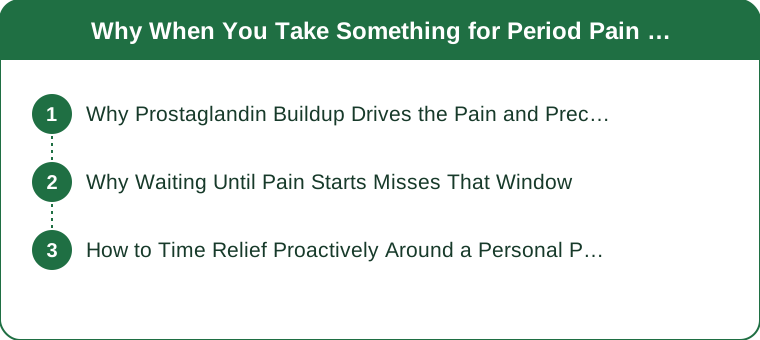
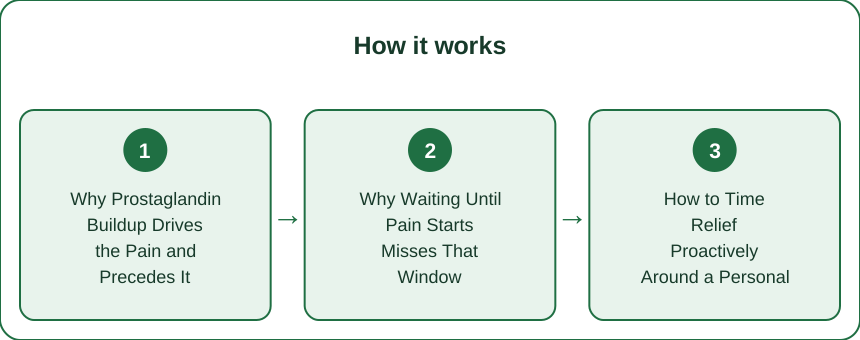
The timing detail that matters: prostaglandin levels begin rising before flow starts and before you feel anything. By the time cramping registers as pain, the process has been building for hours.
So the pain isn’t the start of the event. It’s the point at which an already-underway process crossed your perception threshold.

Why Does Timing Matter More Than Which Medication?
Because the most common over-the-counter option works on production, not on what’s already produced.
NSAIDs — ibuprofen, naproxen, and similar — reduce prostaglandin synthesis by inhibiting the COX enzymes that make them. That’s a preventive mechanism. It slows the creation of new prostaglandins; it can’t retroactively remove the ones already circulating and already driving contractions.
Which explains the common experience: taking ibuprofen at peak cramping produces partial, disappointing relief, while the same dose taken a day earlier works far better. Same drug, same dose. Different amount of prostaglandin already in the system when it arrives.
This is also why the “which one is strongest” debate misses the point for a lot of people. A well-timed dose of a standard NSAID frequently outperforms a poorly-timed dose of anything.
How Do You Time Period Pain Relief Proactively?
Build a personal pattern first, then work backwards from it.
Step 1: Track 3 cycles. For each one, note the day flow starts, the day cramping starts, and roughly when during the day it begins. A period tracking app works, so does a note on your phone. You’re looking for one thing: how consistently does cramping arrive relative to the start of your period?
Step 2: Identify your onset window. Most people find it’s fairly stable — cramping starts the day before flow, or on day one in the morning, or something similarly repeatable.
Step 3: Start relief roughly 24 hours before that point. For many people that’s the day before their period is expected. Talk to your doctor or pharmacist about appropriate timing and dosing for you specifically, since this is a change in how you’re using the medication.
Step 4: Take it on schedule for the first 1–2 days, not reactively. Prostaglandin production continues through early flow, so a consistent schedule maintains the block rather than letting it lapse and restart.
Step 5: Take it with food. NSAIDs irritate the stomach lining, and pre-emptive use means more total doses.
Non-medication approaches that also work best pre-emptively:
- Heat. Heating pads and patches have reasonable evidence for menstrual pain, and applying heat before cramping peaks is more effective than chasing it.
- Regular exercise across the cycle, not just during it, is associated with reduced menstrual pain.
- Consistent sleep and hydration in the days before, which won’t cure anything but reliably makes the experience worse when neglected.
Myth vs. Fact
Myth: You should wait until pain is bad before taking something, to avoid overusing it. Fact: For NSAIDs and menstrual cramps, waiting reduces effectiveness because the mechanism is preventive. Appropriate dosing within package guidance, started earlier, is generally both more effective and no higher in total dose.
Myth: Severe cramps are just something you have to accept. Fact: Pain that stops you from working, going to school, or functioning normally is not a normal thing to endure quietly — it can indicate endometriosis, adenomyosis, or fibroids, all of which are treatable and all of which are frequently diagnosed years later than they should be.
Myth: Exercise makes cramps worse. Fact: Regular physical activity is generally associated with reduced menstrual pain, even though moving during the worst of it can feel unappealing.
Myth: Heat is just a comfort measure. Fact: Topical heat has been studied for menstrual pain and shows real effect, in some studies comparable to over-the-counter analgesics.
When Should You See a Doctor About Period Pain?
Talk to a healthcare provider if any of these apply:
- Pain that interferes with work, school, or daily activities despite over-the-counter relief
- Cramping that has become noticeably worse over time
- Pain that starts several days before your period or continues after it ends
- Very heavy bleeding — soaking through a pad or tampon hourly for several hours
- Pain during sex, bowel movements, or urination around your period
- Any new pattern that’s different from your normal
These can point to conditions with real treatments. “Everyone has cramps” is true and is not a reason to leave a debilitating pattern unexamined.
FAQ
How far in advance should I take pain relief for cramps?
Many people find starting about 24 hours before their typical cramp onset works well, but the right timing and dose depend on your cycle regularity and your health history — this is worth a short conversation with your doctor or pharmacist rather than a guess.
Does this work if my periods are irregular?
It’s harder, since pre-emptive timing depends on predicting onset. Tracking for longer (4–6 cycles) sometimes reveals a pattern, and if it doesn’t, taking relief at the very first hint of cramping rather than waiting for it to build is the next best option.
Are there non-medication options that help?
Heat has reasonable supporting evidence and is the easiest to try, and regular exercise across the month is associated with less menstrual pain overall. Some people find TENS units helpful. None of these replace medical evaluation if pain is severe.
This is general health information, not medical advice. Talk to your doctor or pharmacist before changing how you use any medication, especially if you have stomach, kidney, heart, or bleeding conditions, or take other medications.
TL;DR:
- Prostaglandins drive cramping and start rising before you feel anything
- NSAIDs block new prostaglandin production — a preventive mechanism that can’t undo what’s already there
- Timing frequently matters more than which product you choose
- Track 3 cycles to find your onset pattern, then start relief ~24 hours earlier, on a schedule, with food
- Pain that stops you functioning is worth a doctor’s visit — it can point to treatable conditions
Keep Reading
This article is for general informational purposes only and is not medical advice. Always consult a qualified health professional for guidance specific to you.